
Introduction
E-commerce parcel delivery offers consumers a range of delivery options, including in-store pickup, home delivery, pickup points, and parcel lockers. These alternatives are often evaluated based on their respective climate impacts.
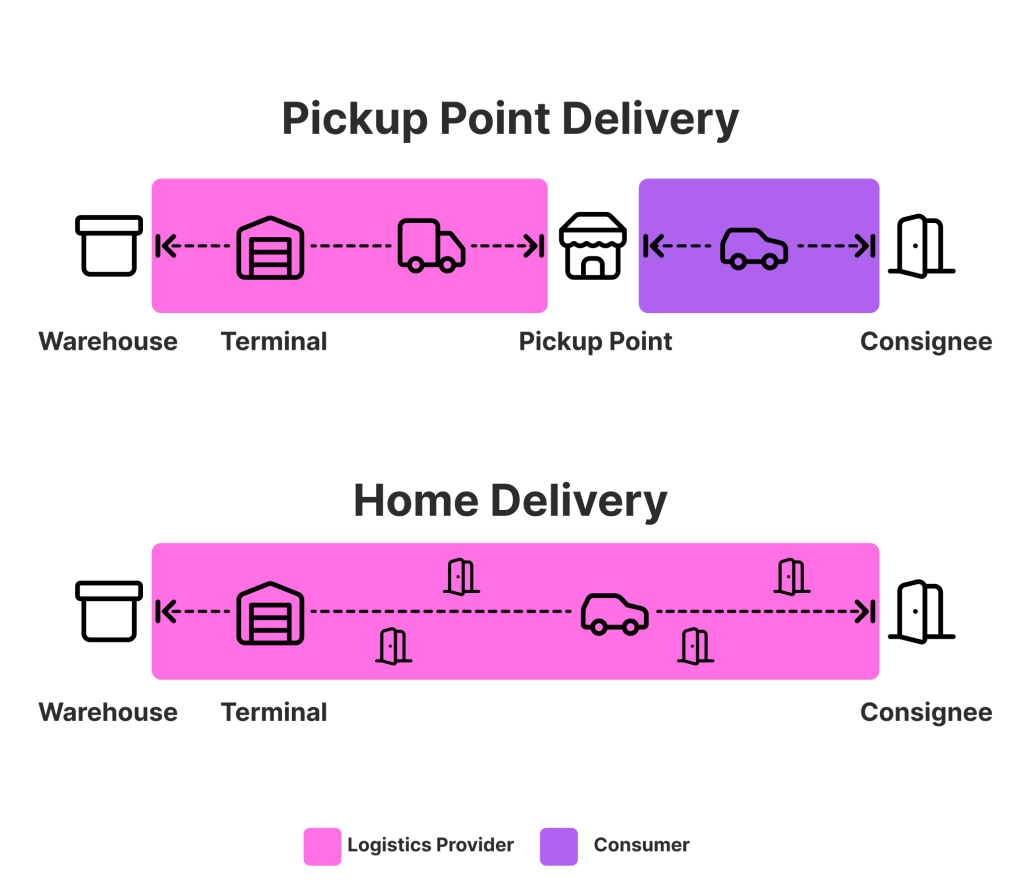
Home delivery involves a logistics provider transporting goods directly from the e-commerce retailer to the customer’s doorstep. In contrast, other delivery options shift part of the transportation responsibility to the customer, who must travel to collect the parcel from a store or designated pickup location.
To meaningfully compare the climate impact of these options, the assessment must apply a consistent system boundary. This means accounting for the entire journey from the e-retailer to the final destination — the customer’s home — including emissions from customer trips to retrieve parcels from pickup points.
The Problem
Currently, no major e-retailers in Sweden are accounting for or reporting the emissions associated with customers’ travel to pickup points. This omission creates several issues:
- Incomplete emission reporting: Emissions from the downstream distribution phase are left out, misleading consumers, stakeholders, and the public about the true climate impact of last-mile delivery.
- Faulty comparisons between delivery options: E-retailers typically compare only the reported emissions from logistics providers based on their scope of responsibility—ignoring the customer’s role in some delivery methods. This results in comparisons that don’t reflect the full picture.
- Misguided strategies and recommendations: Without including the full emissions scope for each delivery option, both e-retailers and consumers may be led to believe certain choices are more sustainable than they actually are. This can result in flawed sustainability strategies and misleading consumer guidance.
Reporting Standards
The standards on this issue are clear. According to the GHG Protocol, emissions from transportation and distribution of products sold by the reporting company in the reporting year between the reporting company’s operations and the end consumer shall be included in reporting1.
Transportation and distribution of products sold by the reporting company in the reporting year between the reporting company’s operations and the end consumer
Two of the GHG Protocol’s core principles are particularly relevant here:
- Relevance: Your reporting should reflect real-world emissions to support informed decision-making.
- Completeness: Account for all GHG sources within your value chain—disclose and justify any exclusions.
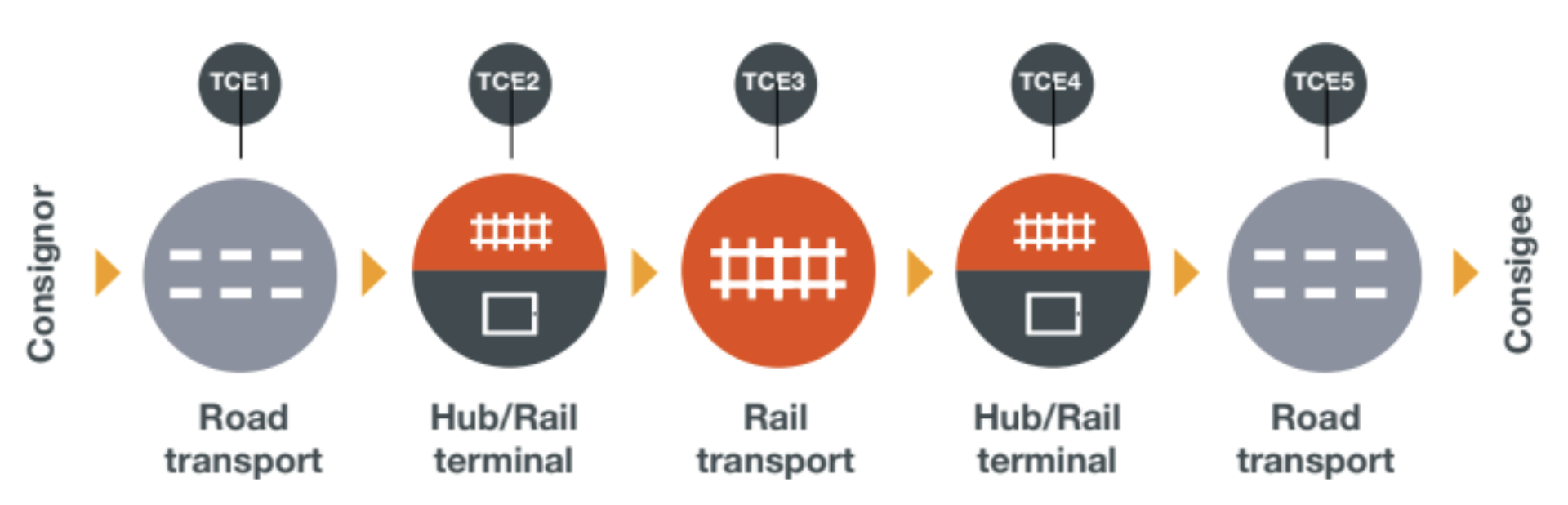
Similarly, the GLEC Framework is unequivocal: the transport chain does not end at the pickup point—it ends when the shipment reaches the consignee.
A transport chain always begins at the point where an item of freight is leaving a consignor, i.e. the point of departure of a shipment, which is often the sender or shipper. It ends when the item reaches its consignee.2
Retail vs. E-retail
Just as retailers with physical stores rely on customers traveling to and from their locations to complete a purchase, e-retailers depend on customers to either choose home delivery or travel to a pickup point to complete the purchase.
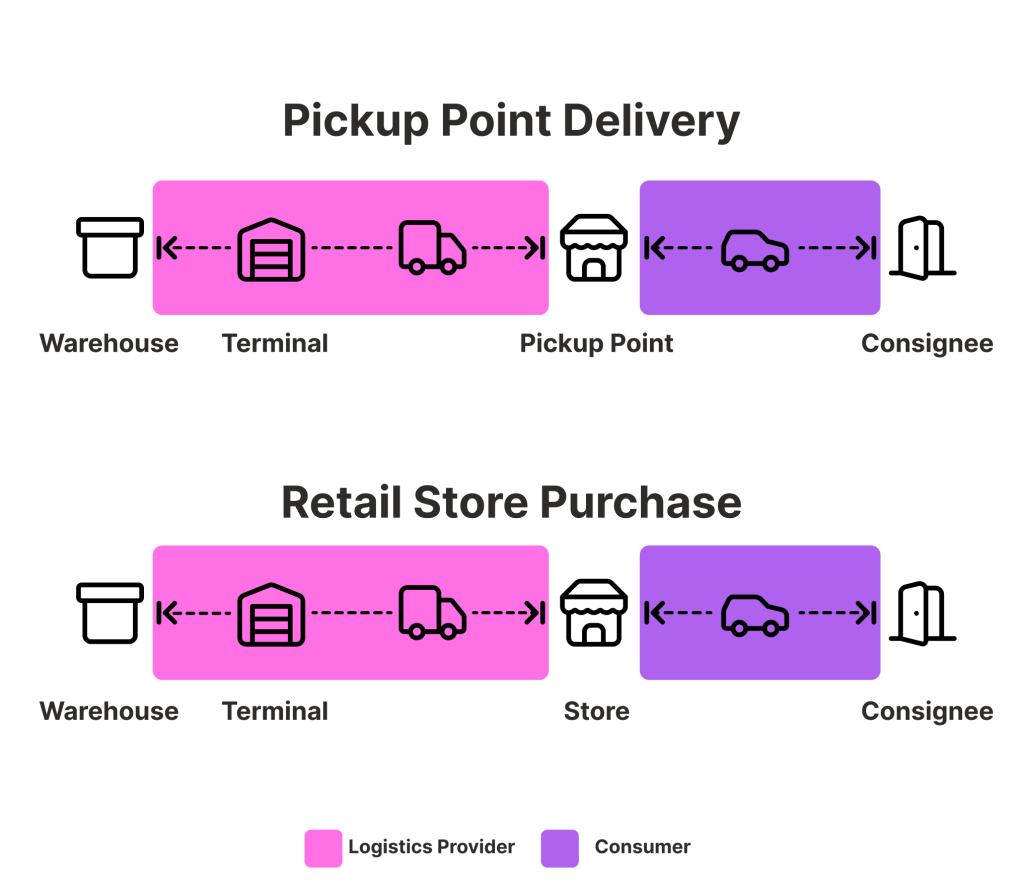
Many brick-and-mortar retailers recognize this and already include customer travel in their emissions assessments—shaping strategies to reduce emissions from this part of the value chain.
IKEA, for instance, has introduced inner-city store formats3, offers free public transportation to its stores4, and provides EV charging stations in its parking lots5. These initiatives aim to minimize emissions associated with customer travel and demonstrate a commitment to addressing emissions beyond the store’s immediate operations.
Last-mile Deliveries
Let’s take a closer look at the final leg of the delivery chain. In Sweden alone, 214 million parcels were delivered in 20246. Of these, approximately 42%, nearly 90 million parcels were delivered to pickup points7.
Under current e-commerce emissions reporting practices, it means 90 million of parcel deliveries had incomplete emissions reporting, as emissions from customer travel to pickup points are currently excluded.
41% of Swedes drive to pick up their parcels, and 87% of them use fossil-fuel-powered vehicles with an average one-way distance to a pickup point of 5.6 km.
While most combine the trip with other errands—averaging 1.7 additional stops—the total distance attributable to a parcel pickup averages 5.9 km for a round trip8.
In 2024, an estimated 217.4 million kilometers were driven by car in Sweden for parcel pickups—equivalent to the annual mileage of approximately 19,300 passenger cars9.
Sweden has a climate milestone target of reducing emissions from domestic transport by 70%, at latest, by 2030. One central approach to reach this target is a more transport-efficient society where traffic volume with energy-intensive modes of transport decreases10.
The e-commerce industry has an important role to play to reach the domestic transport target by offering deliveries that generate the least amount of transport activity.
Home Delivery vs. Pickup Point
In Sweden, a typical home delivery generates around 108 g CO₂e in last-mile emissions11. In contrast, a delivery to a pickup point results in an average of 470 g CO₂e—when accounting for the customer’s travel, which contributes 400 g CO₂e12.
In other words, a pickup point delivery produces more than four times emissions than a home delivery, on average. Yet, 85% of the pickup point deliveries emissions—those related to customer travel—go unreported by all major e-retailers.
The reason for this significant difference is quite simple. On average, a consumer travels 3.6 km round trip to collect a parcel—across all modes of transport, taking multiple errands into account13.
In contrast, a home delivery has an average last-mile distance of just 760 meters per parcel14. This efficiency is achieved because each delivery vehicle distributes tens or even hundreds of parcels per route, rather than just one or a few.
The Case for Pickup Points
There is a valid case for pickup point deliveries—but only under specific conditions.
If the last-mile home delivery is made using a fossil-fuel powered vehicle, then a pickup point may be the better option – if and only if – the customer travels there by foot, bike, or electric vehicle.
However, when home deliveries are made by foot, bike, or electric vehicle, their emissions are just as low as if the customer traveled to a pickup point using the same low-emission modes.
This is why it’s crucial to provide consumers with transparent, comparable and complete information about the emissions of both home deliveries and pickup point options.
Only when equipped with the full picture—considering the entire distance and mode of transport of either option—can consumers make truly informed and conscious choices.
Emissions Gap
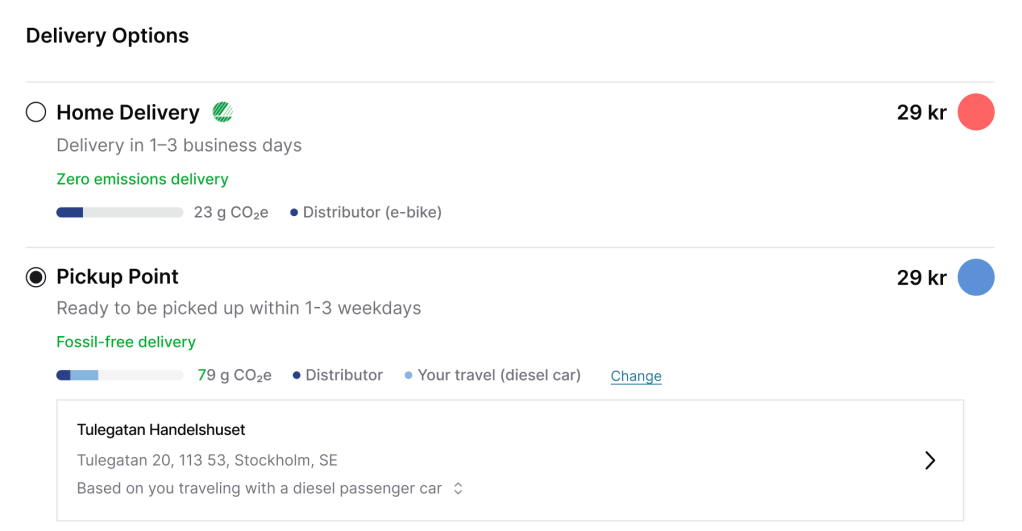
Despite clear guidance on the scope from the GHG Protocol and GLEC, no major e-retailer in Sweden includes consumer travel to pickup points in their emissions reporting. It’s quite remarkable, considering the scale of emissions that occur.
An initial analysis estimates that more than 42,000 tons of CO₂e was unaccounted for last year in Sweden’s e-commerce sector—based on the share of deliveries to pickup points and how Swedes travel to collect their parcels. It is more than many of the distribution companies combined annual emissions.
The exclusion of these transport emissions is inconsistent with the GHG Protocol’s completeness and relevance principles, particularly given the significant scale of the emissions involved.
Moreover, it is leading e-retailers and consumers alike to wrong conclusions about the extent of downstream distribution emissions; where the emissions occur and hence, which actions to focus on and most importantly: what type of delivery to promote, when and where.
A call for e-retailer action
To act responsibly—and in line with established reporting frameworks—it’s time to start accounting for the emissions of customers’ travel to collect their parcels – to provide a more complete and transparent picture of e-commerce’s true distribution impact, for both customers and the wider public.
Actions to take
- Survey your customers: Understand how your customers travel to pickup points— in urban vs. rural regions, what type of transport modes, energy types, travel distances, and how often they combine trips with other errands.
👉 Let us help you – we’ve built the tool you need! - Compare home delivery vs pickup delivery, full scope: See what’s the impact of each delivery type, per parcel and in total, when you include the customer travel in pickup deliveries.
👉 Check out how. - Expand your reporting scope: Start including emissions from consumer travel to pickup points in your sustainability reporting.
- Communicate full delivery scope in your check-out: Display the full delivery emissions in your checkout flow, including emissions from consumer travel to their selected pickup point.
👉 Check out how Apoteket is implementing detailed carbon footprint in their check-out.
References
 aimabel